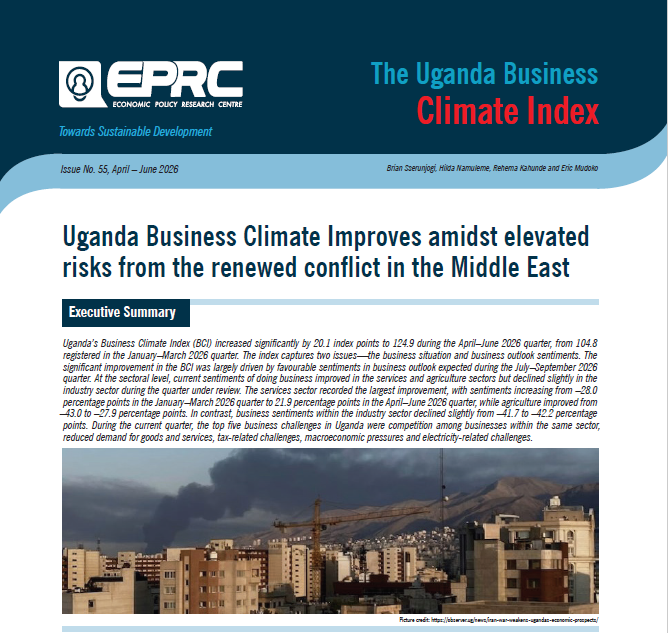
The Economic Policy Research Centre (EPRC) has released the results of its Uganda Business Climate Index (BCI) Survey for the April–June 2026 quarter, revealing a marked improvement in overall business sentiment across the country.
The BCI jumped by 20.1 points to reach 124.9, up from 104.8 recorded in the previous quarter. This improvement was largely driven by strong, optimistic expectations for the upcoming July–September 2026 quarter. At the sectoral level, current operational sentiments improved in the services and agriculture sectors. Services registered the largest gains while the industrial sector experienced a slight decline.
Findings
Presenting the survey results to stakeholders at the Protea Hotel Kampala Skyz on Thursday July 30, 2026, EPRC Research Analyst Ms. Hildah Namuleme highlighted that despite the overall optimism, business owners continue to raise concerns over persistent operational hurdles. Enterprises reported being constrained by an unreliable electricity supply, stiff market competition from industry peers, and ongoing tax challenges.
Namuleme observed that employment trends remained stagnant, with most businesses neither hiring nor laying off staff, a “wait-and-see” posture, reflecting ongoing caution about the future. She added that a scarcity of formal jobs continues to push job-seeking Ugandans into the informal sector or out of the workforce entirely.
The dissemination event brought together key public and private sector stakeholders, including representatives from the Uganda Revenue Authority (URA), the Kampala Capital City Traders Association (KACITA), the Uganda Electricity Distribution Company Limited (UEDCL), and the Ministry of Trade, Industry and Cooperatives.
Mr. Issa Ssekito, Acting Chairperson of KACITA, commended the report for accurately capturing the business impact of geopolitical tensions in the Middle East, which have driven fuel prices up. He expressed concern over proposed fuel tax increases, warning that even minor price adjustments create rapid ripple effects throughout the economy. The proposed tax amendments have not been signed into law, and new tax measures remain pending.
Read the report: Uganda Business Climate Improves Amidst Elevated Risks from the Renewed Conflict in the Middle East
Ms. Keren Chelangat, Supervisor of Rulings & Interpretations at URA, clarified that while URA provides tax policy advice, its core mandate is administrative. She acknowledges the need for expanded tax literacy, so the business community clearly understands their obligations.

Eng. Samson Tondo Ssemakalu, UEDCL Head of Regional Engineering Services, explained that the agency inherited an underfunded power grid that it is actively upgrading. He said that power reliability directly impacts business costs, as firms are often forced to rely on expensive alternative energy sources like generators.
EPRC Executive Director Dr. Sarah N. Ssewanyana stressed that research must lead to actionable outcomes, reiterating the Centre’s commitment to deepening engagement with policymakers, industry leaders, and the public.
Closing the event, Dr. Joshua Mutambi, Commissioner for Internal Trade at the Ministry of Trade, Industry and Cooperatives, affirmed the government’s commitment to addressing the survey’s findings, noting that the persistent structural burdens highlighted in the report demand decisive policy intervention.
Keren Chelangat from URA