
Authored by:


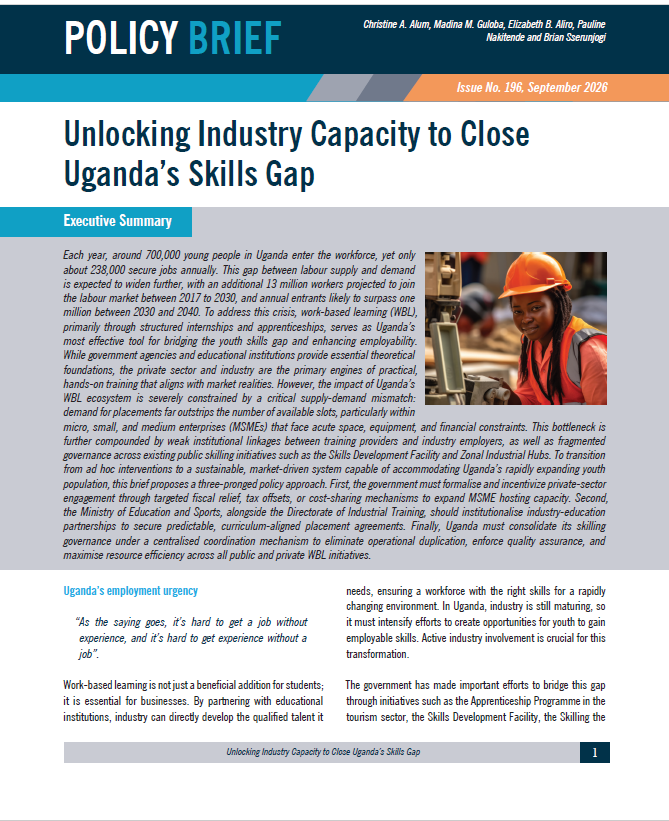
Each year, around 700,000 young people in Uganda enter the workforce, yet only about 238,000 secure jobs annually. This gap between labour supply and demand is expected to widen further, with an additional 13 million workers projected to join the labour market between 2017 to 2030, and annual entrants likely to surpass one million between 2030 and 2040. To address this crisis, work-based learning (WBL), primarily through structured internships and apprenticeships, serves as Uganda’s most effective tool for bridging the youth skills gap and enhancing employability.
While government agencies and educational institutions provide essential theoretical foundations, the private sector and industry are the primary engines of practical, hands-on training that aligns with market realities. However, the impact of Uganda’s WBL ecosystem is severely constrained by a critical supply-demand mismatch: demand for placements far outstrips the number of available slots, particularly within micro, small, and medium enterprises (MSMEs) that face acute space, equipment, and financial constraints.
This bottleneck is further compounded by weak institutional linkages between training providers and industry employers, as well as fragmented governance across existing public skilling initiatives such as the Skills Development Facility and Zonal Industrial Hubs.
To transition from ad hoc interventions to a sustainable, market-driven system capable of accommodating Uganda’s rapidly expanding youth population, this brief proposes a three-pronged policy approach. First, the government must formalise and encourage private sector engagement through targeted fiscal relief, tax offsets, or cost-sharing mechanisms to expand MSME hosting capacity.
Second, the Ministry of Education and Sports, alongside the Directorate of Industrial Training, should institutionalise industry-education partnerships to secure predictable, curriculum-aligned placement agreements. Finally, Uganda must consolidate its skilling governance under a centralised coordination mechanism to eliminate operational duplication, enforce quality assurance, and maximise resource efficiency across all public and private WBL initiatives.
Attached Files
File Action Unlocking Industry Capacity to Close Uganda’s Skills Gap.pdf View - Version
- File Size 235.94 KB
- Published Sep 24, 2026