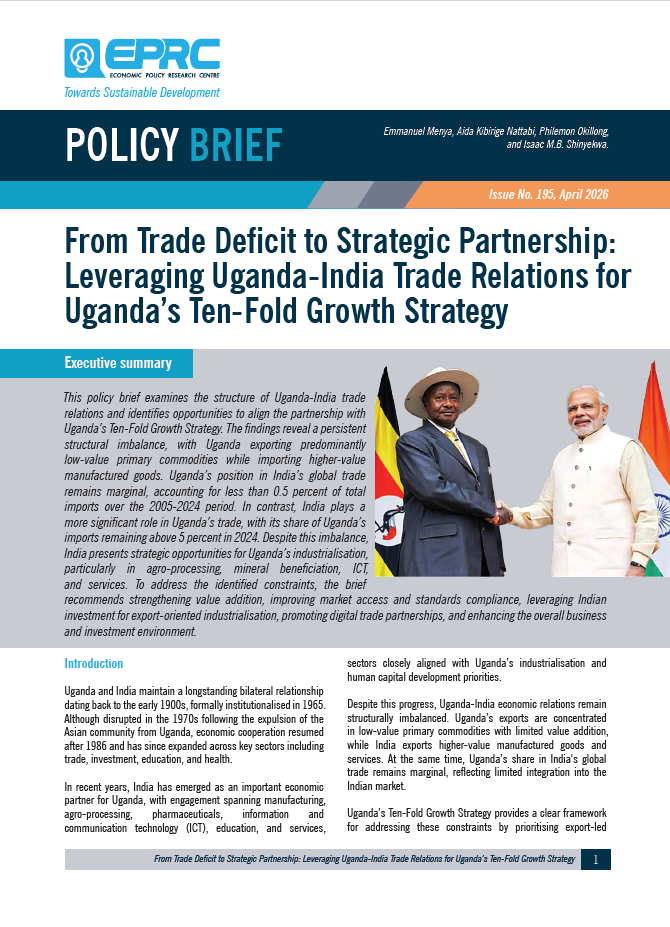
Uganda should build a supportive environment to export its health and education services, capitalising on a rapidly growing regional market, according to industry experts during a recent two-part webinar series.
The discussions were driven by findings from two studies conducted by the Economic Policy Research Centre (EPRC) on the status and potential of both sectors.
EPRC analysis reveals Uganda’s overall trade-in-services deficit reached $2.6 billion in 2025. Positioning health and education as key tradeable services would help close this gap. Between 2015 and 2024, health services exports surged from $3.3 million to $26.8 million, while education services exports grew from $31 million to $103 million. Philemon Okillong, a research analyst at EPRC, noted that regional demand drives this market, with Kenya and Rwanda leading as key consumers.
While health and education are traditionally viewed as social safety nets, experts emphasised their emerging role as economic engines. EPRC Executive Director Sarah N. Ssewanyana explained that developing these exports provides an opportunity to improve the quality and scale of domestic services while positioning Uganda as a trusted regional centre for specialised care and learning.
Dr. Alfred Driwale, Commissioner of Health Services at the Ministry of Health, added that the discussions successfully reframed health beyond a purely consumptive public service. However, significant tracking challenges remain. Current health information systems fail to evaluate services from a financial perspective and omit services provided to groups like refugees.
Dr. Diana Ssewanyana from Aga Khan Hospital Nairobi noted that existing data understates both inbound and outbound patient traffic for treatment.
For the education sector, Brighton Barugahare, Commissioner of Policy Analysis and Research at the Ministry of Education, outlined essential policy shifts. Capitalising on regional potential will require improving overall educational standards, resolving regulatory fragmentation across governing bodies, and addressing the reluctance of learning institutions to share operational data.
Photo/Makerere University Hospital