
Authored by:


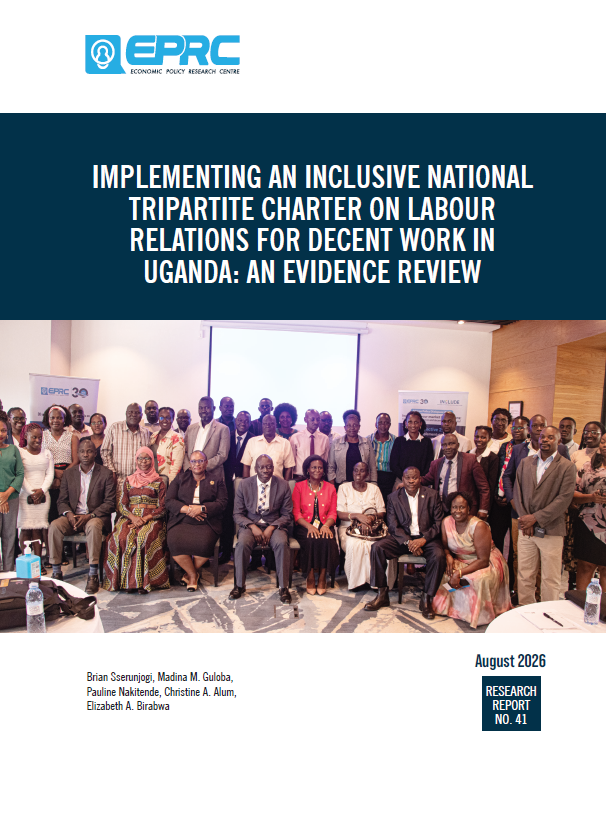
Social dialogue is essential for resolving industrial disputes, promoting workplace harmony, and balancing interests of workers, employers, and government through negotiation and consensus. This review assessed the implementation of Uganda’s 2013 National Tripartite Charter on Labour Relations (NTCLR), its effectiveness in fostering inclusive labour governance, and the legal, operational, and political challenges limiting its impact. It also identifies priority actions for the ongoing review process.
Findings from policy dialogues with government, employers, and workers’ representatives show that the NTCLR has strengthened industrial relations by expanding collective bargaining agreements across sectors such as tea, coffee, hospitality, education, and floriculture. In several export-oriented industries, improved labour standards have enhanced worker welfare and productivity. The Charter has also served as an important operational guide, helping to interpret labour relations where statutory enforcement is weak.
However, the Charter’s effectiveness remains constrained by legal inconsistencies and institutional weaknesses. Contradictions between the Constitution, the Labour Unions Act, and the Employment Act create ambiguity around union formation, recognition, and collective bargaining. The “one union per enterprise” clause is particularly contentious, as it conflicts with constitutional guarantees of freedom of association and has proven difficult to implement in practice.
The continued registration of multiple unions within the same sectors has led to duplication, rivalry, and weakened bargaining power. In addition, the NTCLR is not legally binding and lacks a clear enforcement and accountability framework. Implementation challenges include weak coordination among tripartite actors, limited institutional capacity, slow dispute resolution, inadequate labour inspection, low awareness of the Charter, and insufficient monitoring and evaluation systems.
Political interference and unclear role definitions further undermine trust and effective collaboration. Inclusivity also remains limited. With the majority of Uganda’s workforce in informal employment and increasing participation in digital and gig-based work, many workers, including informal, domestic, and platform workers, remain outside structured social dialogue and labour protections.
To strengthen the revised Charter, priority actions include: i) Reviewing or replacing the “one union per enterprise” with a clearer coordination and negotiation framework consistent with constitutional principles. ii) Clarifying roles, mandates, and communication channels among tripartite partners to improve coordination, transparency, and accountability. iii) Formally recognising emerging forms of work, including digital and gig work, within social dialogue structures. iv) Clearly defining stakeholder responsibilities in organising and integrating informal workers into labour governance systems.
View the report here: Implementing an Inclusive National Tripartite Charter on Labour Relations for Decent Work in Uganda: An Evidence Review
Attached Files
File Action Implementing_an_Inclusive_National_Tripartite_Charter_on_Labour_Relations_for_Decent_Work_in_Uganda._An_ Evidence_Review.pdf View - Version
- File Size 1.80 MB
- Published Sep 3, 2026