Workers’ unions in Uganda have called for wider consultations to ensure the National Tripartite Charter on Labour Relations (NTCLR) adequately addresses the evolving needs of workers across the country.
The NTCLR, signed in 2013 by the Government of Uganda, the Federation of Uganda Employers (FUE), and the National Organization of Trade Unions (NOTU), was established to promote social dialogue, labour peace, and decent employment conditions. It aims to streamline relationships among employers, employees, and workers’ associations.
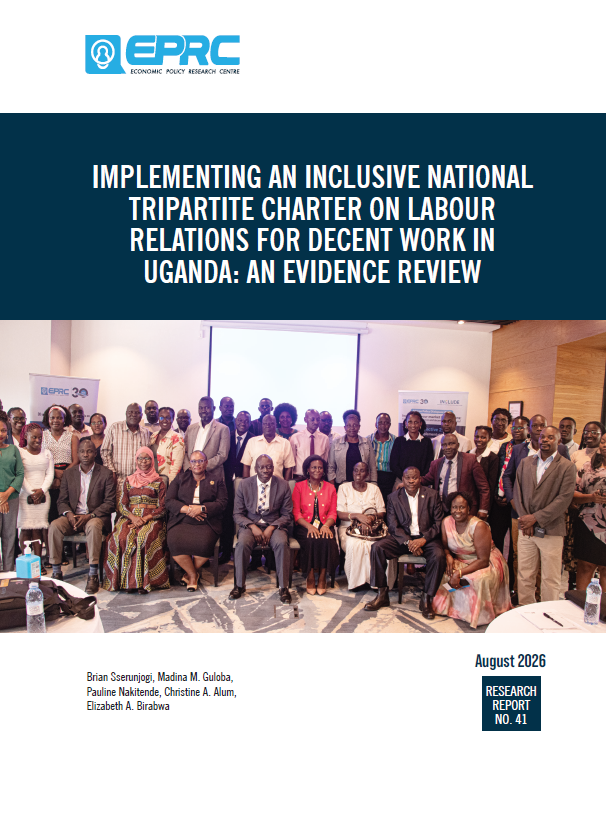
The renewed call for inclusivity was made during a recent consultative meeting held at the Economic Policy Research Centre (EPRC), Makerere University. The meeting sought input from workers’ leaders on how the charter review can be tailored to reflect the changing dynamics of the labour market, including the rise of digital and gig work, and the expansion of the informal sector.
Mr. John Oprong, Chairman of the Uganda Media Union, expressed concern over the breakdown in communication among tripartite members. He noted that political leaders often bypass unions and report directly to the President, undermining the spirit of collaboration.
Mr. John Siel Oketcho, Chairman General of the Uganda Parastatal, Statutory Authority and Judiciary Workers Union, cited the Market Act 2023 as evidence of the tripartite system’s shortcomings. He argued that some provisions in the Act negatively affect certain worker groups, suggesting that consultations were insufficient.
The meeting focused on identifying practical strategies to strengthen tripartite labour relations in Uganda, emphasizing legal consistency, sector-specific approaches, and institutional capacity building. It brought together representatives from the Ministry of Gender, Labour and Social Development, employers, NOTU, the Central Organization of Free Trade Unions (COFTU), and other stakeholders.
Dr. Christine Alum, a Research Fellow at EPRC, said the effectiveness of tripartite dialogue in Uganda was a win not just for the workers but also employers. She outlined five key principles for successful collaboration: freedom of association, independent and representative unions, institutional capacity, political will and mutual recognition, and government support for social dialogue.
Ms. Alice Atim, from the National Union of Government and Allied Workers under NOTU, highlighted that even non-unionized workers benefit from collective bargaining outcomes. She stressed the importance of distinguishing between formal and informal workers, noting that both sectors require tailored representation and support due to their differing structures and operational dynamics.

Ms. Olivia Bitamale, a representative of the Uganda Beverages, Tobacco and Allied Workers Union, sharing her views during a stakeholder engagement at EPRC recently
“Let’s recognize and respect the uniqueness of the informal sector, especially markets, whose unions operate differently,” she said.
Mr. Oketcho of COFTU cautioned that proposed charter revisions must not conflict with existing legislation, particularly the Public Service Negotiating and Consultative Machinery Act of 2008.
“That Act already provides a legally binding framework for collective bargaining in the public service, allowing professionals such as nurses and paramedics to negotiate on labour matters,” he said. He emphasized that the Act’s parliamentary endorsement gives it greater legal weight than newer policies, warning against policy decisions driven by political excitement or external pressure without solid legal grounding.
Dr. Madina M. Guloba, a Senior Research Fellow at EPRC, commended the unions’ commitment to workers’ welfare and underscored the need for increased financial and institutional support for labour inspection systems to operate effectively.
The NTCLR outlines a framework for cooperation among the three social partners—government, employers, and workers—to enhance workers’ rights, improve productivity, and foster a positive work environment through negotiation, conciliation, and arbitration.