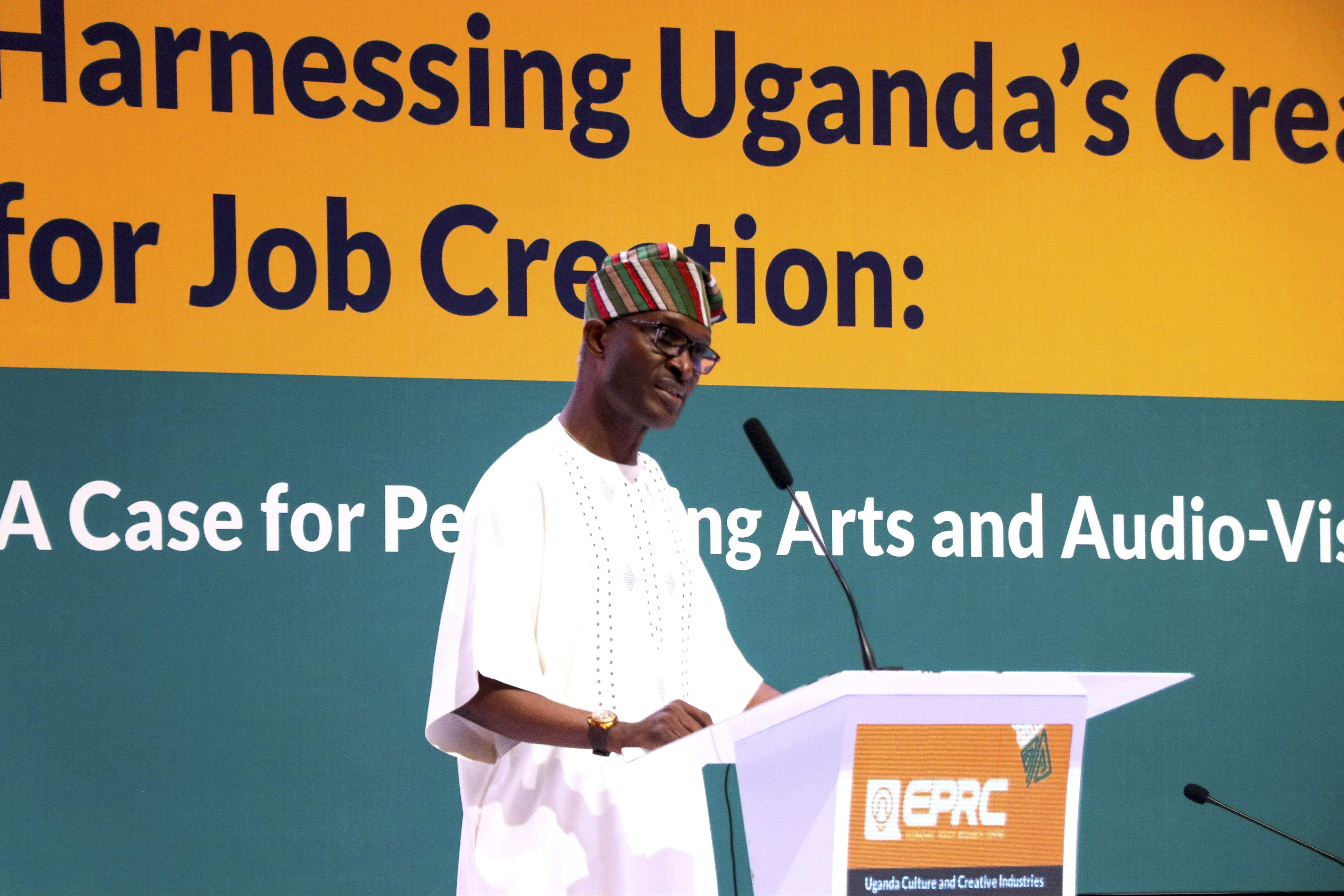
Finance Minister Hon Henry Musasizi has pledged Government of Uganda’s support for the culture and creative arts industries.
“I want to assure you that the Government of Uganda is fully behind what you are doing. This is why in the ten-fold strategy we included (culture) and creative arts industry as one of our anchor sectors that will lead the country to a $500bn economy [by 2040],” Hon Musasizi said.
The minister was speaking during a high-level policy dialogue on “Harnessing the culture and creative industries in Uganda for job creation” held at Serena Hotel on November 26, 2026. The dialogue was organised by the Economic Policy Research Centre (EPRC).
He applauded EPRC for hosting the policy dialogue and for bringing the culture and creative industries into the mainstream discussion for national planning and budgeting.
Hon Musasizi noted that the GOU’s ten-fold strategy is anchored onto investment in agro-industrialisation, tourism, mineral development and science technology and innovation, including ICT and creative arts.
He added that the government prioritises the arts as key for boosting jobs and domestic resource mobilisation. Specifically, he said, the sector is anticipated to double in its contribution to GDP from 3 to 6% and grow its share of employment from one to 5%. The government also intends to facilitate its export earnings and revenue contributions growth.
The 2024 census counted 354,115 persons in the culture and creative industries occupation which is about 3% of Uganda’s working populations. This underscores the significance of the sector’s role in jobs creation.
Dr Kizito Ogedi Alakwe presented the Nigerian perspective
Dr Kizito Ogedi Alakwe, an academic at Nigeria’s Pan-Atlantic University, gave keynote address and used the platform to pose a rhetoric question: “What does it take for a country to turn its creative talent into a productive economic industry?”.
“Across Africa, we have been very good at celebrating our creative talent. But the big paradox is that it has not been supported,” he said. “Are we investing enough to enable these talents to earn sustainable living?”.
He noted that Nigeria’s creative talent has managed to grow because of deliberate policy support with facilities provided to help the sector create without cost and structural hindrances. This year, the arts, entertainment, and recreation industry ranked among Nigeria’s fastest growing sectors, contributing 12% growth in quarter two of 2026, according to media reports.
Creative Industry as Business
Mr Julius Kyazze, the CEO of Live54+ and co-founder of Swangz Avenue, gave an address on Uganda’s perspective, noting that creativity as a business was not different from any other business. It uses the same fundamentals, he said.
He emphasized the need to build enablers or infrastructure to support the industry, arguing that dishing out money to individual creatives for the sake of it may not be the solution to address the issues impacting the sector.
On the infrastructure deficit, he noted that Uganda has one place – the Uganda National Theatre – to consume art. The Theatre sits only 377 people. This compared to Nigeria where Lagos has one that sits 3,000 people.
“The entire country does not [have space to consume art],” he said, adding that financial institutions fear the creatives sector because, “it is not bankable and lacks sharable infrastructure”.

Mr Julius Kyazze speaking during the dialogue
Mr Ivan Bourton, the EU Delegation in Uganda’s Programme Manager, Culture and Stabilisations and Governance, said the EU was already supporting Uganda’s creatives sector and was ready to support it even the more.
He noted that EU firms were read to bring in capital to support Uganda’s creators. He also noted that EU is 450 million consumers’ market and this could bring revenue to creators.
Mr Hewetson Ainembabazi, a Research Analyst at EPRC, presented the culture and creatives sector status in Uganda. The dialogue attracted participants from the culture and creatives sector, funders, government and the academia.

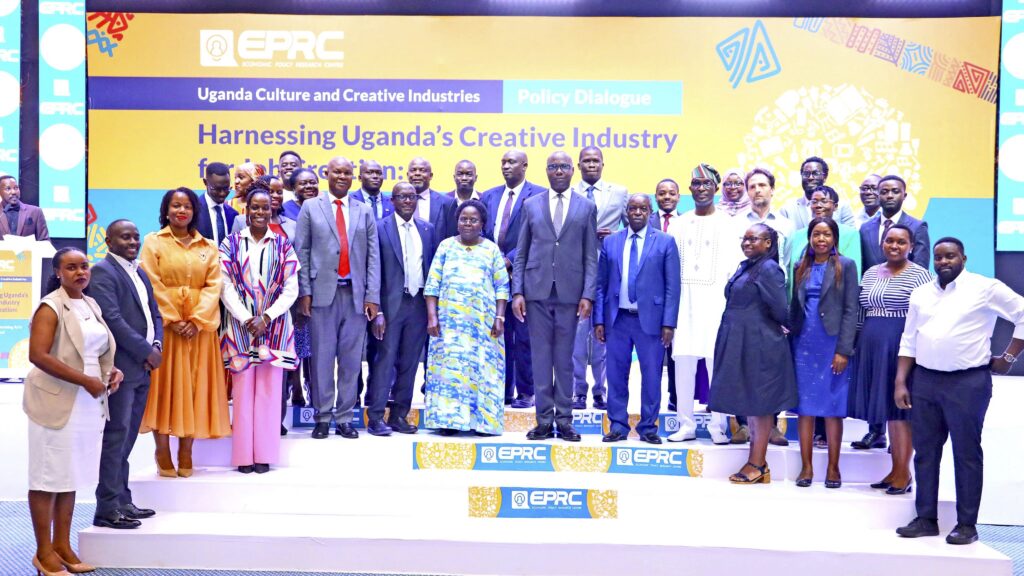
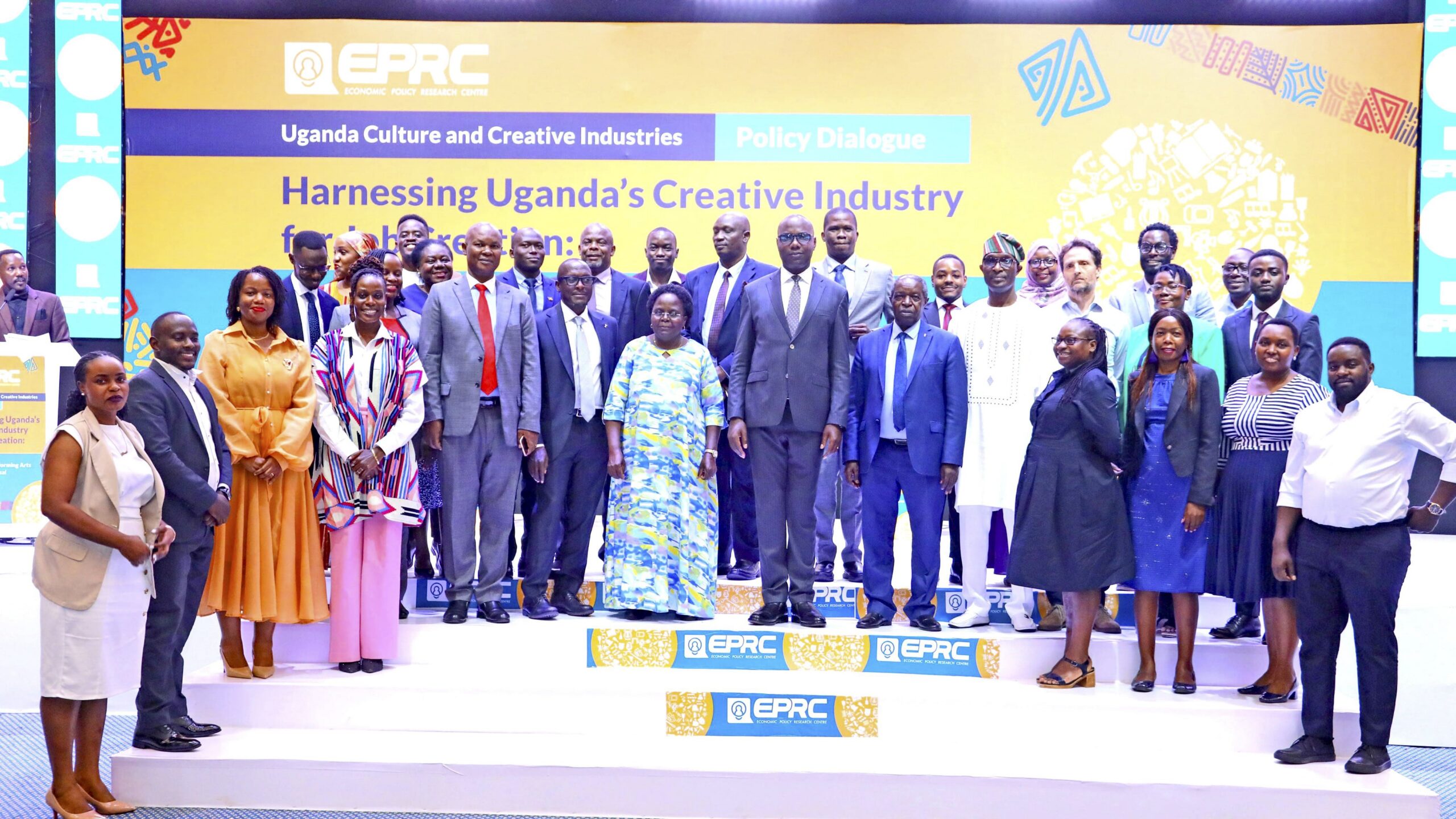
Participants at the dialogue on culture and creatives industries policy dialogue pose for a photo.