Micro, Small, and Medium-sized Enterprises (MSMEs) constitute over 90% of Uganda’s private sector, employing more than 3 million people (MTIC, 2024). As of 2022, the national electricity connectivity rate stood at 57% (19% on-grid and 38% off-grid), leaving about 43% of households and enterprises without access to electricity (MEMD, 2022; UEDCL, 2023).
While Uganda Electricity Distribution Company Limited (UEDCL), the power distributor, reported an 18% expansion of its distribution network in 2022/23, including 21% growth in low-voltage lines to close connection gaps, the utility still faces a backlog of over 127,000 pending connections, reflecting persistent access challenges linked to inadequate funding and material shortages (UEDCL, 2023; 2024; UETCL, 2024).
For rural and peri-urban MSMEs, the burden is greater attributed to the high costs of grid extension to sparsely populated settlements, limited capacity to stock connection materials, remain barriers to access. These constraints explain why a substantial share of Uganda’s MSMEs remain unconnected or underserved by reliable electricity, thereby limiting their ability to scale up, drive economic and industrial transformation.
Persistent challenges in the electricity sector were repeatedly highlighted by Parliament, based on the findings particularly through the Committee on Environment and Natural Resources during the review of the Electricity (Amendment) Bill, 2022. The Committee observed that Uganda’s power sector continued to grapple with high tariff rates, dilapidated distribution networks, and unreliable supply to customers, all of which constrained affordability and undermined industrial productivity.
The report further stressed that the country faced a significant deficit in transmission and distribution infrastructure, with an estimated US$ 2.5 billion and US$ 1.5 billion required respectively for upgrades, levels of investment that could have not be sustained under the prevailing concession model with UMEME since its private and profit making. It also noted the need to reduce tariffs for manufacturers, who consume nearly 70% of national demand, to improve competitiveness (Parliament of the Republic of Uganda, 2022). Collectively, these findings demonstrated systemic weaknesses in the country’s distribution framework.
Considering persistent challenges in power reliability and affordability, the Government of Uganda decided not to renew Umeme’s 20-year electricity distribution concession upon its expiry on 31 March 2025, with Umeme formally handing over its distribution assets to the state-owned Uganda Electricity Distribution Company Limited (UEDCL), signifying a shift back to public-sector control (Electricity Regulatory Authority, 2025).

UEDCL, the power distributor, total power stability will be achieved in about a year’s period.
Through this transition, the government aims to enhance service efficiency, reduce electricity costs, ensure universal access and affordability, in alignment with national development goals (Electricity Regulatory Authority, 2025). To that end, Ministry of Finance acquired USD 50 million (UGX 183 billion) from Absa Bank as capital investment into UEDCL to inherit power distribution operations from 1 April 2025 (UEDCL, 2025).
This funding formed part of a broader strategy to inject USD 350 million (UGX 1.2 trillion) into Uganda’s electricity grid over the next five years, aimed at refurbishing dilapidated infrastructure, lowering tariffs, and expanding reliable access (UEDCL, 2025). These measures clearly demonstrate government’s intention to strengthen service efficiency, reduce electricity costs, and align power distribution more closely with national development priorities under Vision 2040 and NDP IV.
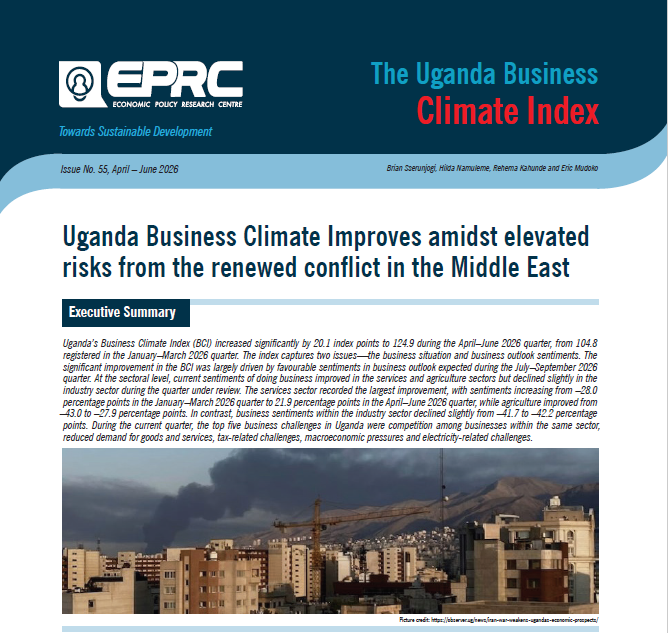
Despite the reforms and MSME centrality to Uganda’s economic fabric, these enterprises operate under several business constraints, Key of which is power outages. Indeed, according to findings from the Economic Policy Research Centre’s (EPRC), the Business Climate index survey of April to June 2025 quarter revealed that 42 percent of business establishments reported having experienced power outages in the period under review. Energy reliant sectors such as manufacturing and service sectors, accommodation and food service activities, health services, and agro processing are impacted the hardest.
To overcome power stability issues, Uganda can draw valuable lessons from regional peers such as Kenya’s Last-Mile Connectivity Project (LMCP) that have made meaningful progress in electrification. Kenya’s Last-Mile Connectivity Project (LMCP), launched in 2015, provides a compelling model for accelerating MSME electrification through targeted, cost-effective infrastructure rollout. The project sought to leverage Kenya Power’s 35,000 distribution transformers to extend low-voltage networks and connect at least 284,200 households and 30,000 commercial customers (SEAF, 2021).
An impact evaluation by the African Development Bank of LMCP Phase I reported an 83% increase in access to grid electricity for lighting, though it noted that productive uses such as powering MSMEs and income-generating activities remained limited (AfDB, 2021). These gains were achieved through measures such as subsidised connection fees and concessional financing. Importantly, the LMCP also benefited from strong government commitment, partnerships with development financiers including the World Bank, African Development Bank, and the European Union which reduced connection fees from KSh 35,000 to KSh 15,000 increasing affordability for low-income households and small businesses (World Bank, 2016).
Uganda could therefore adapt this model by embedding a demand-driven, MSME-focused electrification component within its Rural Electricity Access Project, prioritising industrial clusters, agro-processing hubs, and trading centres while introducing tailored subsidies and financing mechanisms to align with the Tenfold Growth Strategy and NDP IV. This would ensure electricity access directly supports MSME growth and broader socio-economic transformation
In conclusion, access to stable and affordable electricity is fundamental for Uganda’s MSME growth, productivity, and inclusive national development. With sustained government investment and strategic partnerships, electricity access can be expanded and reliability enhanced. However, if outages persist, MSMEs will remain trapped in low productivity and limited scalability, undermining Uganda’s broader goals of industrialization and socio-economic transformation.
References
African Development Bank (AfDB). (2021, November 11). Evaluation of Last Mile Connectivity Project (LMCP) shows significant positive impact and need for productive use of electricity. African Development Bank Group. https://afdb.africa-newsroom.com/press/evaluation-of-last-mile-connectivity-project-lmcp-shows-significant-positive-impact-and-need-for-productive-use-of-electricity
Economic Policy Research Centre (EPRC). (2025). Uganda Business Climate Survey Q2 2025. Kampala: EPRC.
Electricity Regulatory Authority (ERA). (2025). Government of Uganda takes over electricity distribution.https://www.era.go.ug
Ministry of Energy and Mineral Development (MEMD) (2022). Energy Policy for Uganda 2023. Kampala: Government of Uganda.
Ministry of Trade, Industry and Cooperatives (2024) State of entrepreneurship in Uganda 2024. https://www.mtic.go.ug/wp-content/uploads/2025/01/MSME-profile.pdf (Accessed: 2 September 2025).
Parliament of the Republic of Uganda. (2022). Report of the Committee on Environment and Natural Resources on the Electricity (Amendment) Bill, 2022.
Parliament of the Republic of Uganda. (2022). Report of the Committee on Environment and Natural Resources on the Electricity (Amendment) Bill, 2022.
Sustainable Energy Access Forum Kenya (SEAF). (2021). Assessment of Last-Mile Connectivity Project in Kenya. Nairobi: SEAF. https://seafk.org/wp-content/uploads/2021/10/LMCP-Working-Brief-_Assessment-of-Last-Mile-Connectivty-Project-in-Kenya-1.pdf
Uganda Bureau of Statistics (UBOS). (2023). Statistical Abstract 2023. Kampala: Uganda Bureau of Statistics.
Uganda Electricity Distribution Company Limited (UEDCL). (2023). Annual Report 2022/23. Kampala: UEDCL. https://www.uedcl.co.ug
Uganda Electricity Distribution Company Limited (UEDCL). (2024). UEDCL commits to clearing electricity connection backlog by December 2025. Kampala: UEDCL. https://www.uedcl.co.ug
Uganda Electricity Distribution Company Limited (UEDCL). (2025). UEDCL acquires UGX 183 billion from Absa Bank to support electricity distribution takeover. Kampala: UEDCL. https://www.uedcl.co.ug
Uganda Electricity Transmission Company Limited (UETCL). (2024). Annual System Performance Report 2023/24. Kampala: UETCL.
World Bank. (2016). Project appraisal document on a proposed credit to the Republic of Kenya for the Last-Mile Connectivity Project. Washington, DC: World Bank.