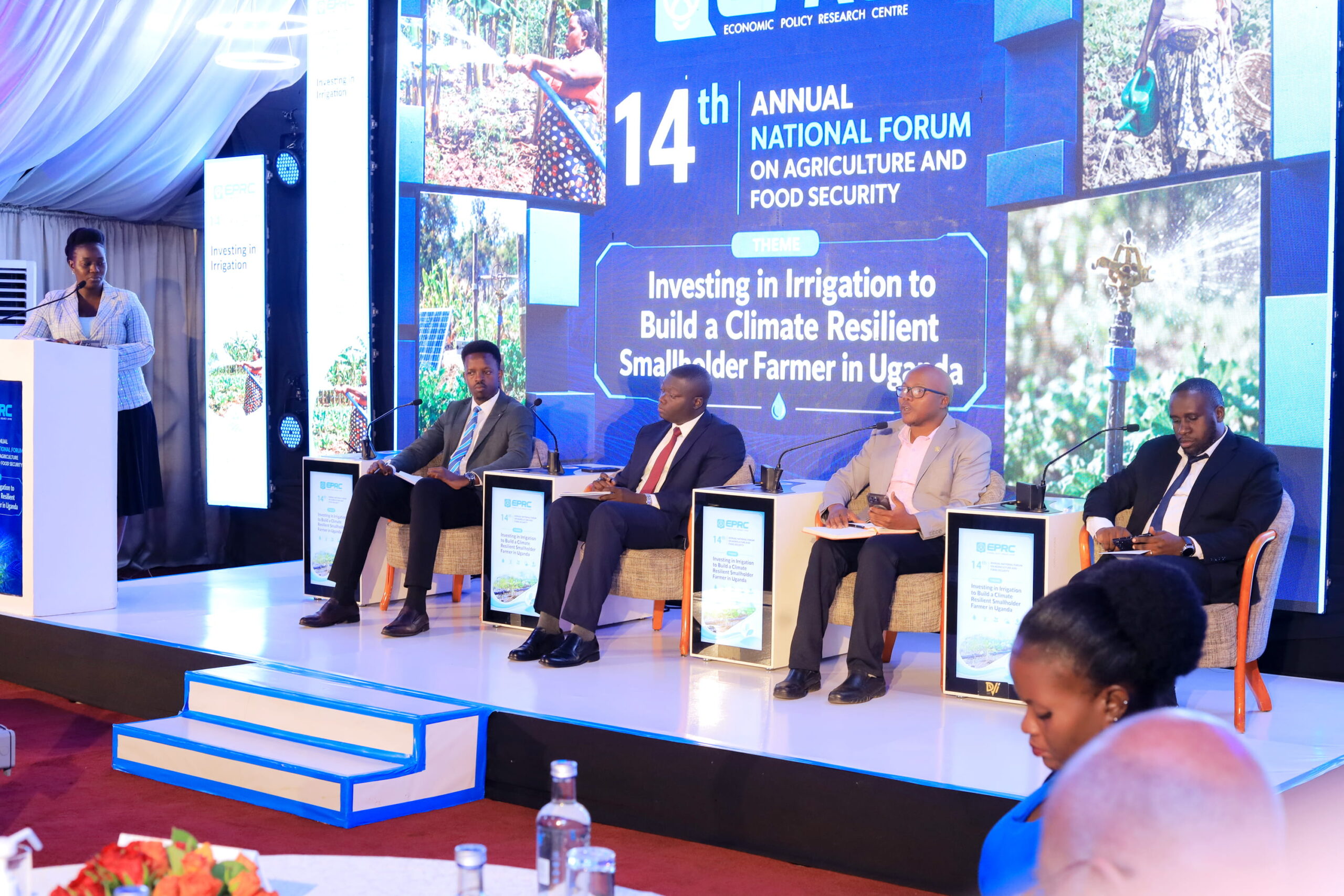
Stakeholders in the agricultural, finance, public and private sectors have urged government and donors to increase investment and facilitation of uptake of smallholder farmer targeted irrigation schemes.
The call was made during the 14th Annual National Forum on Agriculture and Food Security hosted by Economic Policy Research Centre (EPRC) at Sheraton Kampala Hotel on June 4, 2026. The forum ran under the theme, Investing in Irrigation to Build a Climate Resilient Smallholder Farmer in Uganda.
EPRC Executive Director Dr Sarah Ssewanyana said the “deliberate choice of the word “investing” signals that irrigation is not a peripheral expenditure, but a long-term commitment of public, private and household resources whose returns must be measured in resilience, productivity and dignity at the farm gate.”
The case for investment in irrigation is particularly strong as nearly all of Uganda’s agriculture remains rain-fed. Dr Ibrahim Kasirye, the EPRC Director of Research, represented Dr Ssewanyana.
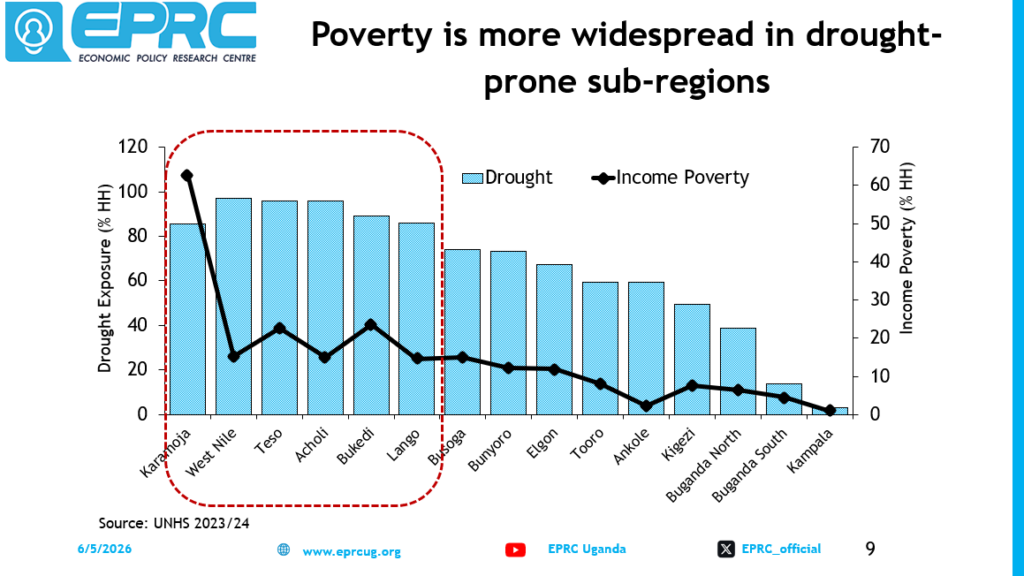
While presenting an EPRC assessment of the small-scale irrigation status, Dr Christine Arwata Alum, a Research Fellow, said regions that used less irrigation and experienced drought stress also faced income poverty. This points to the link between agricultural productivity and household earnings. In some communities, drought is widespread with nine out of ten households in Northern Uganda reporting having experienced one.
Alum stressed that the government and donors’ shift of focus to small scale irrigation initiatives that reach individual farmers is a welcome move even when it still faces many challenges.
Eng. Francis Waneloba, the Water for Agricultural Production Assistant Commissioner at the Ministry of Agriculture, said: “Only 3% of arable land in Uganda is under irrigation which means that it is not possible for farmers to take advantage of the fertile land that they have [because they cannot plant in dry seasons]”.
Opportunities
To Ms. Harriet Nattabi, a Senior Water Resources Specialist at World Bank Uganda, “sub-Saharan Africa holds some of the most underutilised water resources in the world. And expanding irrigation could generate over 200million jobs with roughly over 4 jobs per irrigated hectare.”
She added: “Even modest increases in agricultural productivity can significantly reduce poverty. A 10% increase in agricultural productivity can reduce poverty by up to 3%. Uganda is well positioned to take advantage of this opportunity. The resource base exists. What has been missing is the pathway from potential to impact.”
Ms. Nattabi applauded steps that have been taken by various actors to promote microscale irrigation programmes. These have been able to give farmers irrigation awareness and training, plus match up funding from the government.
The forum noted that irrigation should be accompanied with other services to make an investment sense to farmers. Ms. Nattabi noted that irrigation without a market is irrigation without impact.
Mr. Joseph Okee, from the Ministry of Agriculture Directorate of Extension, advised that small-scale irrigation initiatives should ensure adoption of the technologies, which means sustained use by the farmers and not just coverage.
The forum was attended by stakeholders from government ministries, departments and agencies; donor partners including UN and its agencies; embassies; and the private sector. EPRC hosts the forum annually to address critical issues impacting agricultural productivity and food security in the country.
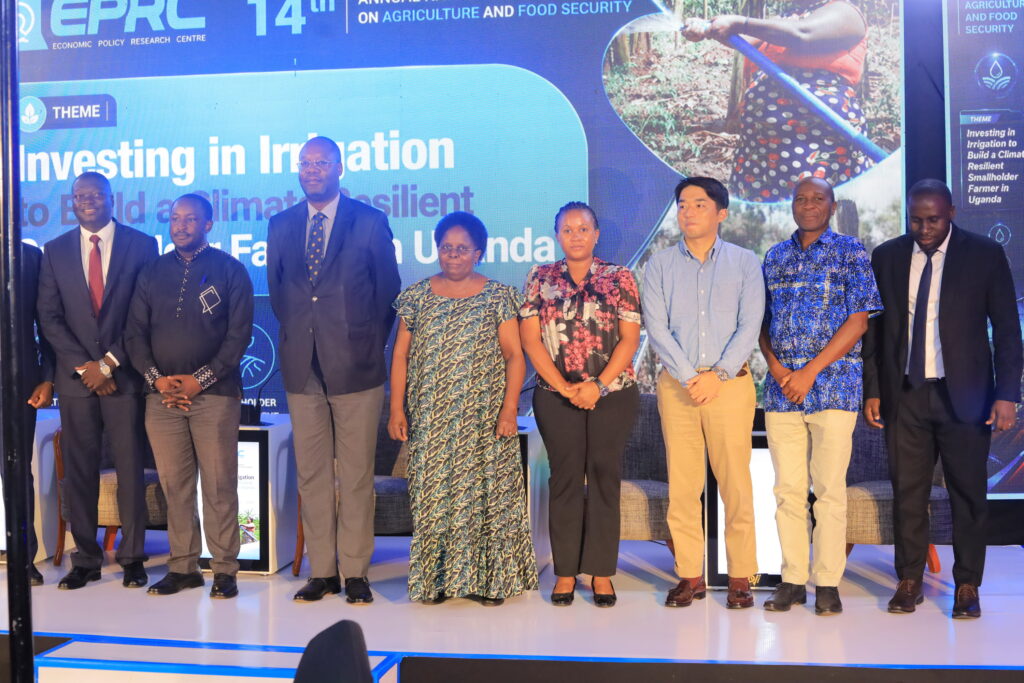
Mr Leonard Zulu, the United Nations Resident Coordinator (RC) for Uganda (3rd Left) and EPRC Executive Director Dr Sarah N Ssewanyana, (4th Left) with other delegates at the EPRC 14th Annual National Forum on Agriculture and Food Security held at Sheraton Kampala Hotel on June 4, 2026