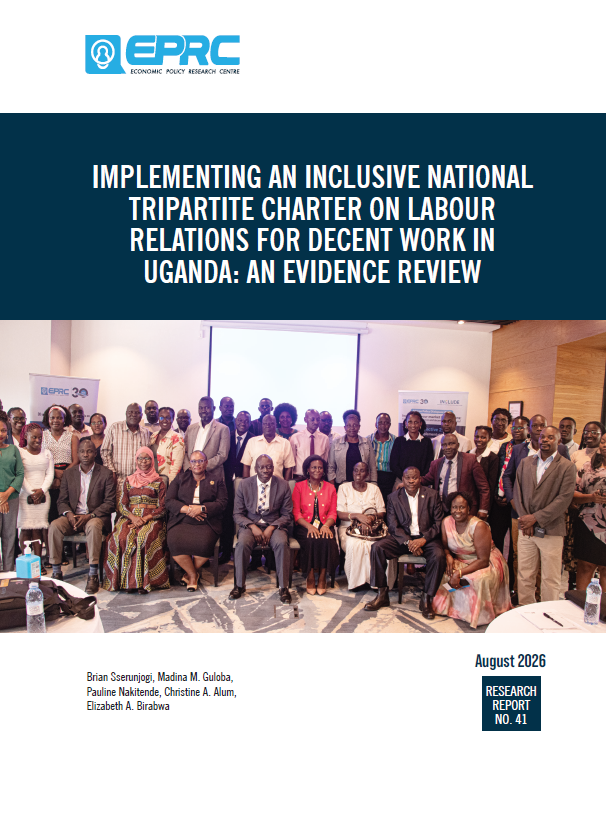
Stakeholders have called for urgent creation awareness regarding the provisions and significance of the National Tripartite Charter on Labour Relations (NTCLR) to effectively reorganise the relationships among employers, employees, and workers’ associations in Uganda.
The call was made during a recent dialogue hosted by the Economic Policy Research Centre (EPRC) that gathered representatives from the government, employers, employees, workers’ unions, and the Judiciary. During the meeting, it was stressed that many people in Uganda were unaware of the charter and thus unable to implement its provisions effectively.
The NTCLR was signed in 2013 by the Government of Uganda, the Federation of Uganda Employers (FUE), the National Organization of Trade Unions (NOTU), and the Central Organisation of Free Trade Unions (COFTU). It was established to promote social dialogue, labour peace, and decent employment conditions. The charter is currently undergoing a review to cater for the evolving needs of today’s workforce.
It was also noted that the implementation of the charter largely relies on the goodwill of the participants, which has significantly limited its effectiveness.
Accordingly, it was suggested that the charter be elevated into national planning instruments, such as being integrated into Uganda’s National Development Plan to ensure government accountability.
Furthermore, it was recommended that the charter be aligned with domestic laws, including the Employment Act and the Labour Unions Act, to legally recognise gig and domestic workers. Participants recognised that the charter currently remains a guiding framework rather than a binding legal document.
The EPRC was applauded for bringing key stakeholders together to share their views on the charter and ways to improve it. The research is supported by the INCLUDE Platform.
The Industrial Court Head Judge Justice Linda Lillian Tumusiime Mugisha participated in the dialogue.