From Promises to Actions: Shifting gender norms and public perceptions about unpaid care work in workplaces and families in Uganda

Unpaid care work is widely undervalued and disproportionately done by women. In Uganda, women and girls spend around twenty hours per week on unpaid care work—twice as much time as men and boys.
The COVID-19 crisis has exacerbated the unpaid care burden and increased the demand for home care. This disproportionate burden constrains women’s ability to participate in paid employment. Through a Project titled “From promises to action: Shifting gender norms and public perceptions about unpaid care work in workplaces and families in Uganda”, a consortium of three organisations – Makerere University’s School of Women and Gender Studies, Economic Policy Research Centre, and CARE International in Uganda – will undertake a study to explore what strategies are most effective and scalable to reduce and redistribute the women’s unpaid care work burden.
Purpose
The generated evidence is expected to inform policies and community actions to further address social and gender norms, especially in the COVID-19 context. The project seeks to design interventions that will actively examine, question, and change the rigid gender and social norms (GSNs) and perceptions to contribute to Recognition, reduction, redistribution, and representation of Unpaid Care Work at all levels of the woman’s socio-ecology.
The project will also identify impact pathways for shifting attitudes, norms and behaviours at different levels. It will forge strategic partnerships with key stakeholders especially the Government of Uganda (GoU), religious leaders and cultural leaders to ensure the uptake of the research evidence and scalability of the POWER model interventions in Uganda’s development agenda.
Project objectives
The main objective of the project is to explore the scalability of a promising intervention –the POWER model – for shifting gender and social norms and public perceptions on Unpaid Care Work in Uganda. Specifically, the project seeks to:
- Map out the Gender Social Norms and perceptions on Unpaid Care Work (UCW) at family, community and institutional levels in order to inform the needed interventions to address women’s disproportionate care burden
- Test the effectiveness and portability of the POWER model and the modifications needed for addressing UCW
- Inform policy and community actions on ways to address adverse social and gender norms related to UCW and how these can be scaled up
Target audience
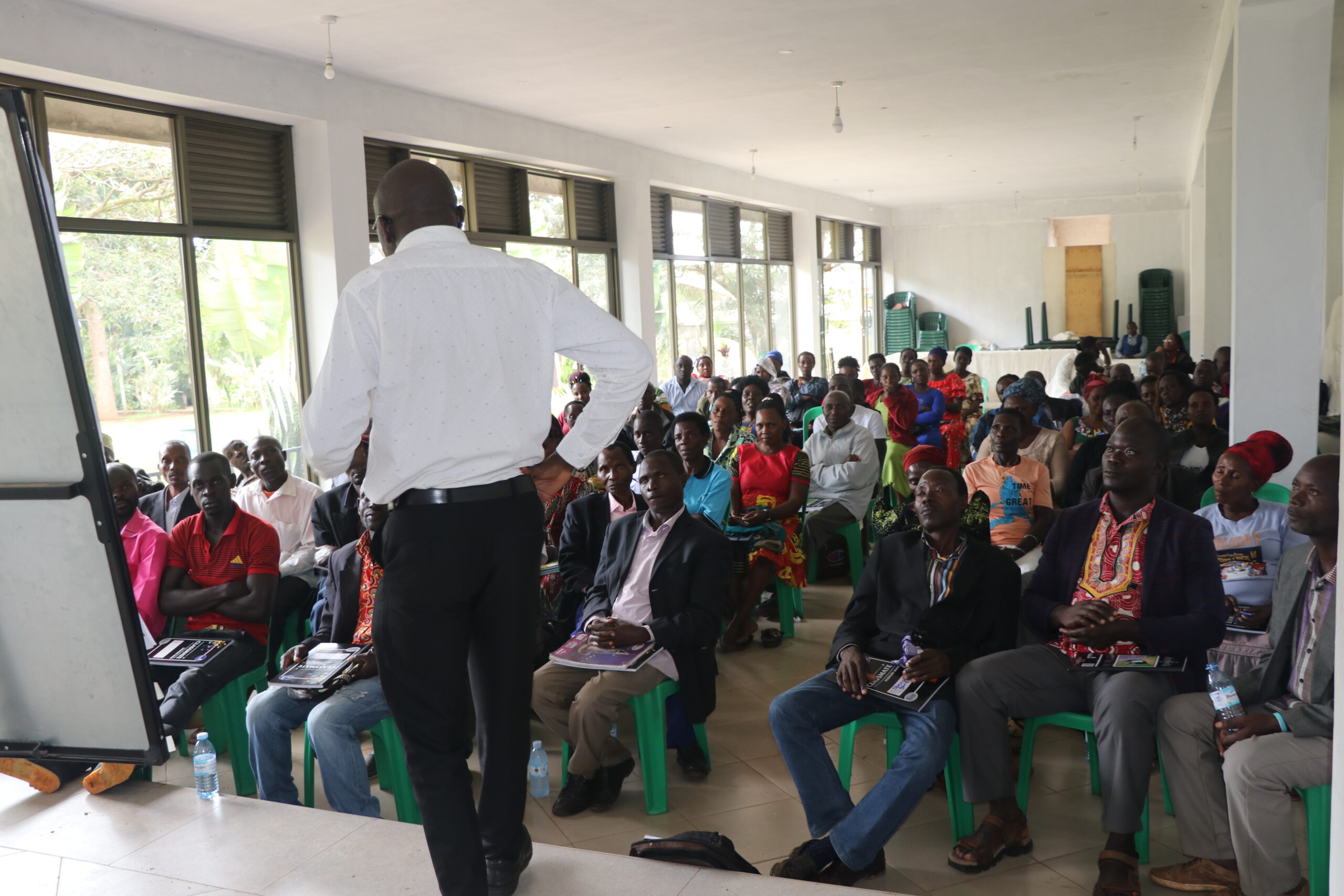
The target audience includes policymakers, political leaders, cultural leaders, religious leaders, media, relevant CSOs, ordinary households.
Project approach
The Project will adopt an experimental research design following a Randomized Control Trial (RCT) to test the effectiveness of the POWER model interventions on shifting these norms on UCW.
The RCT approach allows for control of confounding factors, comparison, and attribution of the efficacy of the intervention and minimization of bias and sampling errors.
The interventions happen at different levels – individual, household/family, community and institutions.
The Project intends to engage key stakeholders throughout the Project’s lifetime. This is intended to mobilize and increase the uptake of the evidence that will be generated from the Project.
Project activities/outputs
- Women trained in financial management, gender relations about Unpaid Care Work
- Men and boys engaged and trained to challenge Unpaid Care Work
- Communities engaged and sensitized to challenge Unpaid Care Work
- Local-level duty bearers and service providers engaged
- Policy actors and partners are engaged to implement the existing policies
Short term output
- Improved recognition and redistribution of UCW at household, community, and policy levels
- Recognition and inclusion of UCW in policies and development plans
- Resourcing of UCW in national and sub-national plans and budget
- Private sector and CSO recognition of UCW in policies and plans
- Positive social gender norms on UCW emerge and are practiced by families
Long term output
- Increased participation of women in paid work and women empowerment